Author Archives: Lili Whalen

Assignment 4: The Effects of Slavery

Lili Whalen

Micheal Rumore

British Literature II: Restoration Through Revolutions

Writing Assignment #4: Period Recap

15 May 2020

                                                            The Effects of Slavery

            Throughout this class, I was able to obtain a deeper understanding of the eighteenth century by learning what enslaved Africans have gone through, and what enslaved woman have done in order to escape slavery. Aphra Behn, who was a white woman, focuses on the cruelty towards African Americans and how they were affected by slavery in the novel, Oroonoko or, The Royal Slave. Behn zooms in on the love affair between Prince Oroonoko and Imoinda. Little does Imoinda know that her love for Oroonoko will have major repercussions. On the other hand, Phillis Wheatley, who is considered to be the first African American to have published writing is also an emancipated slave. Wheatley writes about her own experience as a slave as well as her views on religion in her poem, “On Being Brought from Africa to America.” In this poem, Wheatley writes as an enslaved person about how she is taken from her homeland to a foreign country. She also divulges how far from Christianity she is. Wheatley states, ” ‘Their colour is a diabolic die.’ / Remember, Christians, Negroes, black as Cain, / May be refin’d and join the’ angelic train” (6-8). In these lines, Wheatley places the sixth line in quotation marks to highlight what Caucasian people have said about African Americans. She also displays how far apart she is from the Christian religion, while referencing that God punished Cain for murdering Abel. In another poem of Wheatley’s, “An Hymn to Humanity,” she goes more into detail about her views on Christianity. For instance, she begins her first line by writing, ” … dark terrestrial ball” (1). Wheatley refers to the word, “ball” as earth, while challenging Christianity, since she sees the religion as rejecting African Americans. Throughout these works of literature, the class is able to see Imoinda and Wheatley’s journey unravel as African American women.

            In Oroonoko or, The Royal Slave, Imoinda’s love for Oroonoko comes with a cost when the king, Oroonoko’s grandfather, seeks to have a sexual relationship with Imoinda. However, when the king learns that she is in love with Oroonoko, he punishes both Oroonoko and Imoinda by selling them off as slaves. During Imoinda’s enslavement, she was able to rekindle her relationship with Oroonoko, who was surprised to see her, since his grandfather had him believe she was deceased. While Imoinda was enslaved, she displayed a strong and brave disposition as she stood by Oroonoko to fight against the slave owners. Behn states, ” … heroic Imoinda, who, grown big as she was, did nevertheless press near her lord, having a bow and a quiver full of poisoned arrows, which she managed with such dexterity that she wounded several, and shot the Governor into the shoulder” (Manifold). In this passage, Imoinda is pregnant with Oroonoko’s child, but continuously fights for her and her family’s freedom. This also reveals that Imoinda will do whatever it takes to make sure her family is safe. However, both Oroonoko and Imoinda were not able to free themselves and did not succeed in the revolt against the white slave owners. The only way Imoinda and her unborn child are able to be free is if Oroonoko puts them out of their miseries. Oroonoko stabs Imoinda to death. Behn writes: 

 … the lovely, young, and adored victim lays herself down before the sacrificer; while he, with a hand resolved, and a heart breaking within, gave the fatal stroke, first cutting her throat, and then severing her yet smiling face from that delicate body, pregnant as it was with the fruits of tenderest love. As soon as he had done, he laid the body decently on leaves and flowers, of which he made a bed, and concealed it under the same cover-lid of nature. (Manifold)

Imoinda was given an opportunity that not many slaves have, to die in peace by the hand of someone she loves. She agreed to be killed by her husband in order to liberate her unborn child from growing up not only as a slave, but being raised in a country filled with fear. 

            Phillis Wheatley was another woman who acquired the luxury of being liberated from slavery. Wheatley was emancipated from her slave owners after her published poems led to her fame. Wheatley was captured from Africa when she was eight years old. Her poems describe her experiences as a slave. In her poem, “On Being Brought from Africa to America,” she reminisces about when she was forced to leave her country. She also discusses her views on religion by stating, ” ‘Twas mercy brought me from my Pagan land, / Taught my benighted soul to understand / That there’s a God, that there’s a Saviour too” (1-3). When Wheatley says, “Pagan land,” she points out that she has different religious views than others. She then mocks the Christianity religion, since she is trying to comprehend if there really is a God that looks over her since she was enslaved. She then goes into more detail onto how she was treated as a slave. Wheatley says again, “Some view our sable race with scornful eye” (5). Throughout this poem, she writes about her views towards Christianity. When she touches on Cain and Abel in this peace, she is alluding that people see her and other African Americans as prodigies of Cain. 

            In another poem of Wheatley’s, “An Hymn to Humanity,” questions the world she lives in, as she implies that the “ball” is earth. She continues to examine the earth as she reflects of herself by calling herself a lyre. Wheatley states, “For when thy pitying eye did see / The languid muse in low degree, / Then, then at thy desire / Descended the celestial nine; O’er me methought they deign’d to shine, / And design’d to string my lyre” (25-30). In this fifth stanza, Wheatley speaks through an instrument as she describes how she was treated when she was enslaved. She recalls the slave owners making themselves look good by mistreating her. This piece explores the topic of humanity, while the slave owners are dehumanizing her and treating her as if she was an animal.

            Throughout Oroonoko or, The Royal Slave, “On Being Brought from Africa to America,” and “An Hymn to Humanity” displays what Imoinda and Wheatley have experienced while they were enslaved. Although they have been through a lot, these two women showed their strength throughout their enslavement while Imoinda fought the white slave owners and Wheatley wrote down her experiences and feelings while she was enslaved. However, both of these women were able to become free of their slavery, even if it meant dying or becoming a famous poet. However, although Wheatley was an emancipated slave, but her years of slavery have made her so exhausted. Unfortunately, her life was cut short when she passed away at thirty-one years old. This displays that even though both Imoinda and Wheatley have tried so hard to separate themselves from the life of slavery, they never fully recovered from the wounds that it has brought them.
Critical Annotation

Lili Whalen 

Professor Micheal Rumore

English Literature II Restoration through Revelations 

Critical Annotation

April 22, 2020

  1. “He was pretty tall, but of a shape the most exact that can be fancied: the most famous statuary could not form the figure of a man more admirably turned from head to foot” (Behn). 

      The narrator in the novel, Oroonoko; or, The Royal Slave describes in vivid detail in how she remembers meeting Prince Oroonoko. When the narrator describes how he looks, she uses the word, statuary, but how can she explain Oroonoko as a statue if he is a person? There are many ways to use the word statuary. According to the Oxford English Dictionary, statuary derives from the time period, 1759, and is referred to as something or someone looks similar to a statue. In other words, Oroonoko possesses qualities of a statue since he is tall and appears to be handsome in the narrator’s opinion. 

2. “So that having made his first compliments, and presented her an hundred and fifty slaves in fetters” (Behn).

      This line in Oroonoko; or, The Royal Slave symbolizes irony because Oroonoko is gifting his lover, Imoinda, slaves that are in chains, where him and Imoinda eventually end up as well. This line makes me wonder if Behn is foreshadowing on what is going to happen to Oroonoko and Imoinda since he presents her with slaves in order to show his love for her. However, the love that they have for one another eventually gets them in trouble when Oroonoko’s grandfather sells them as slaves. When Oroonoko murders Imoinda and their unborn child in order to save them from living a life without freedom, does he finally understand the brutality of owning slaves? After killing the love of his life, he then ends his own life using the same knife. 

3. “At length, the travellers began to ascend among the Apennines. The immense pine-forests, which, at that period, overhung these mountains, and between which ten road wound, excluded all view but of the cliffs aspiring above, except, that, now and then, an opening through the dark woods allowed the eye a momentary glimpse of the country below” (Radcliffe).  

         In The Mysteries of Uldolpho, Ann Radcliffe captivates the readers’ attention by setting the tone of the story by painting a picture in the readers’ minds in the beginning of chapter five when she goes into elaborate to detail to discuss the scene. The setting appears dark and gloom, almost as if it is foreshadowing that something bad is going to happen. After Radcliffe places descriptive images of the setting, the readers see Emily, the main character, who is surrounded by the vivid scenery. In Eveline van der Lans’ work of literature, “Ann Radcliffe’s The Mysteries of Udolpho and the Function of Landscapes in Gothic Fiction” states, ” … Radcliffe provides the reader with a specific aesthetic experience, one that involves emotions of terror and suspense” (Van der Lans 12). Since Radcliffe provides a sequence of pictures throughout this novel, she invites readers on her toes imagining they are there in the story with the characters. 

4. ” ‘The colour is a diabolic die’ ” (Wheatley 6).

      Phyllis Wheatly, who is known for being the first African American woman to be a published writer, draws attention to her poem, “On Being Brought From Africa To America” as she discusses her journey from Africa to America. she places this line in quotes because she is recalling what she has heard people say about her race. The word diabolic is referred to as ” … belonging to, or involving the Devil or a devil” (Oxford English Dictionary). People are referring to African Americans as diabolic because of the color of their skin. 

5. “We were now landed upon the continent of Africa, the most desolate, desert, and inhospitable country in the world” (Defoe).

      In Daniel Defoe’s excerpts of “Captain Singleton,” the narrator refers to Africa as being as deserted and unwelcoming. Both the narrator, Captain Singleton and Defoe are taking the continent for granted. While Captain Singleton is on his journey, it seems that he is complaining about the hot desert, lack of food, and have come across in what he refers to as savages. As Captain Singleton continues on his voyage, he decided to ” … quarrel with some of the negro natives, take ten or twelve of them prisoners, and blinding them as slaves, caused them to travel with us, and make them carry out baggage; which I alleged would be convenient and useful many ways as well to show us the way, as to converse with other natives for us” (Manifold). By Captain Singleton coming to Africa and taking African citizens against their will is taking advantage of the continent. Captain Singleton seems selfish and only does what is best for him. 

                                                      Works Cited

Behn, Aphra. Oroonoko; or, The Royal Slave. Manifold, January 2007. 

Defoe, Daniel. “Captain Singleton.” Captain Singleton, Manifold, 1720.

            “Statuary.” Oxford English Dictionary.

Radcliffe, Ann. “Chapter 5.” The Mysteries of Udolpho , vol. 2, Manifold, 1794.

Van der Lans, Eveline. “Ann Radcliffe’s The Mysteries of Udolpho and the Function of   Landscapes in Gothic Fiction.” Leiden University, Leiden University, 13 June 2016, 

            openaccess.leidenuniv.nl/bitstream/handle/1887/45784/MA%20Thesis%20Eveline%20va            n%20der%20Lans%20s1146947%20final.pdf?sequence=1.

Wheatley, Phyllis. “On Being Brought From Africa To America.” Manifold, 1773. 

Lili Whalen’s Reading Communities

Lili Whalen 

Professor Micheal Rumore

English Literature II Restoration through Revelations 

Reading Communities Blog

April 14, 2020

                                                            Through Thick and Thin

            Growing up in Catholic household from parents who both grew up in the Bronx and then raising two kids in Sleepy Hollow, New York, in a Catholic household taught my sister and I to be obedient and to respect each other, and how important family is. When taking the course, British Literature II: Restoration Through Revolutions at Lehman College, I was introduced to varieties of works of literature with characters being taking advantage of in the eighteenth century when they obey their superiors and being betrayed by their own family. In Aphra Behn’s novel, Oroonoko or, The Royal Slave, which was published in 1688, displays that the royal family of the European coastal fort, previously known as Coramantien, will deceive each other in order to get what they want.

            Once the king, who is Oroonoko’s grandfather, tried to pursue Oroonoko’s lover, Imoinda, takes a disastrous turn when the king finds out that she is not a virgin. The fact that she  was intimate with Oroonoko and is in love with him makes the king jealous. The king gets his revenge on both Oroonoko and Imoinda by selling them as slaves. Behn states, “He ought to have had so much value and consideration for a maid of her quality as to have nobly put her to death, and not to have sold her like a common slave; the greatest revenge, and the most disgraceful of any” (Manifold). The king thinks that death is not enough of a punishment, so he sells her as a slave. In order for the king to make the penalty even more ruthless, he lets his own grandson believe that the love of his life was killed. However, the king lets Oroonnoko believe he had killed Imoinda in order for Orooonoko to suffer. 

            When I first read this novel, I was in shock because where I come from, family is supposed to be a steppingstone and a support system, not hurting our loved ones. I was appalled that a grandfather, who had many mistresses and wives, would try to pursue his grandson’s lover. My parents have taught me to be grateful for what I have and to not take anything for granted. The fact that the king who owns a lot of possessions and comes from lots of wealth, will do anything in his power to make sure his loved ones undergo great pain, displays how miserable he is. 

            In my family and community, we scold upon grandfathers or fathers who would try to pursue a relationship with their children’s lover. My mom and I watch a lot of soap operas, including General Hospital and Young and the Restless. On these shows, a lot of families are killing each other in order to get revenge since they are having an affair with their lover. I love watching these kinds of shows because it so different from the kind environment that I grew up in. My family and  I believe that communication, trust, love, and being there for one another is key to a strong bond with family. We also believe that revenge is petty and would never do anything drastic in order to get revenge on one another. It is a shame that Oroonoko’s grandfather could not look past his jealousy and would sell his own grandson and lover as slaves. 

            Different from his grandfather, Oroonoko saves a pregnant Imoinda from raising their unborn child in slavery when he stabs her to death and then stabs himself using the same knife. Behn writes, Behn writes, “Caesar with his arm’d Hand, met him so fairly, as stuck him to the heart, and he fell dead on his feet” (Manifold). Although it is against my Catholic religion to harm ourselves, as well as our loved ones, Oroonoko was doing what he thought was best for his family, just like my parents have saved my sister and I by teaching us that family is what is most important in life.

                                                            Works Cited

Behn, Aphra. Oroonoko; or, The Royal Slave. Manifold, January 2007. 

Archival Project: The Impact of Slavery

Lili Whalen 

Professor Micheal Rumore

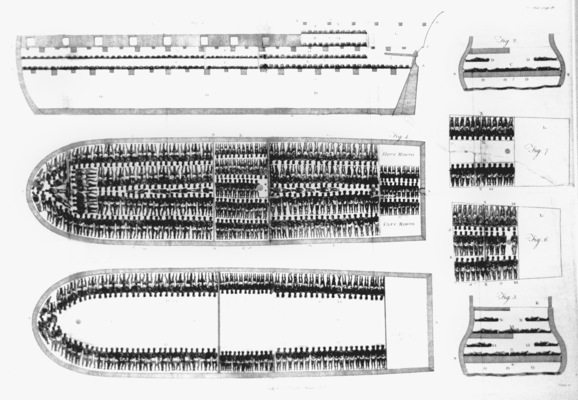
Circa 1750, A diagram showing how slaves were packed into the hull of a ship, some standing, some sitting. (Photo by Henry Guttmann/Getty Images)
circa 1865: A shirtless black slave stands with his hands tied to a whipping post as a white man, possibly his master, prepares to begin the beating. Stocks are built on a platform on the whipping post. (Photo by Samuel N. Fox/George Eastman House/Getty Images)

English Literature II Restoration through Revelations 

March 14, 2020

                                                            The Impact of Slavery

            The eighteenth century was a time where slavery was in high demand. Slaves were forced on ships with poor conditions and very small spaces. They were taken away from their families and into the unknown. Slaves were also beaten if the owners felt that they committed a misconduct. In Aphra Behn’s novel, which was published in 1688,Oroonoko or, The Royal Slave, Oroonoko, who is an African Prince in the European coastal fort, Coramantien, which is now known as Ghana. Oroonoko is eventually separated from his lover, Imoinda, where they are both sold to the English and arrive in a colony called Surinam, today known as Suriname. This colony is located in South America, but more specifically, the West Indies. Since Oroonoko was separated from the woman he loved, he can relate to others who were also captured and forced to be enslaved and had to part ways from friends, family, and loved ones. 

            In an illustration, “Whipping Post and Pillory, Delaware,” depicts an enslaved African tied to a pillar who is shirtless where a Caucasian man is beginning to whip him. This image takes place in 1865, which was found in the Lehman College Database, Slavery and Anti-Slavery Archive. Similar to this illustration, Oroonoko was also whipped by his owner, Byam, since Oroonoko decided to rise against the slavery institution. When Oroonoko’s fellow slaves were forced to surrender because they were intimidated by a large army, this resulted in Oroonoko being whipped. The narrator states, ” … we went up to the Plantation to see Caesar; whom we found in a very miserable and unexpressible Condition … He could never pardon Byam; as for Trefry, he confess’d he saw his Grief and Sorrow for his Suffering (Behn 69). Oroonoko, who was later known as his slave name, Caesar, was betrayed by his fellow slaves because of their surrender. Oroonoko and the enslaved African displayed in the illustration were not only held against their will, but by being exposed in a vulnerable state to all the other slaves on the plantation. This shows that both men have had their personal honor and dignity stripped away from them. 

            In the second illustration, “Slave Transport,” is portrayed as a diagram, which was drawn by Henry Guttmann in 1750. This image displays many slaves pressed together on a ship, either standing or sitting, which can be very distressing during the long voyages. This image exhibits how slaves were treated, especially on the slave ships. The front of the ship shows various rooms labeled as “Bed place,” which are located towards the sides of the ship. In the center of the bed areas, there is a large triangular area classified as “Birth” and “Seamen’s.” In the “Seamen’s” section, a person who is steering the ship is usually positioned in that room. The ship that Oroonoko was on is expressed as ” … clapping great Irons suddenly on the Prince, when he was leap’d down into the Hold, to view that part of the Vessel; and locking him fast down, secur’d him” (33). Similar to the illustration, Oroonoko was treated poorly by the captain and workers of the vessel, forced to be held down by the heavy chains. Oroonoko and his guests were being held against their will just like the slaves in Guttmann’s illustration. 

            In Venture Smith’s narrative, which was published in 1798 by C. Holt, A Narrative of the Life and Adventures of Venture, A Native of Africa: But Resident above Sixty Years in the United States of America. Related by Himself, depicts a young boy who comes from a royal family in Guinea, which is a country located in West Africa. An army invaded the family’s territory and demanded money. Smith’s father, Saungm Furro, was “Prince of the Tribe of Dukandarra” (Smith 5). The army ” … interrogated respecting his money which they knew he must have. But as he gave them no account of it, he was instantly cut and pounded on his body with great inhumanity” (Smith 10). After this torture, Furro passed away without the army knowing where he had kept his fortune. 

            After the death of Smith’s father, the army then captured Smith, who was six years old at the time. The army took him as well as his people as prisoners. This led to Smith becoming enslaved in the United States. He later married a woman named Meg and had a baby, while still a prisoner. Similar to Oroonoko, Smith had come from a royal family and would do anything to protect the ones he loves. Oroonoko murdered his wife and unborn baby in order for them to escape the injustices of slavery. This was Oroonoko’s way of saving his family. On the other hand, Smith was able to purchase his freedom, and later, his wife and children. Smith was also able to buy property and boats. Smith says, “Since my residence at Haddam neck, I have owned of boats, canoes and sail vessels” (Smith 29).Smith is the ideal of slaves who would have done anything to buy back their freedom and the one’s they loved. Oroonoko did not have this opportunity, which led him to stab the love of his life, Imoinda, and then kills himself using the same knife. Behn writes, “Caesar with his arm’d Hand, met him so fairly, as stuck him to the heart, and he fell dead on his feet” (75). Oroonoko’s life ended tragically, but like the prince he is, he ended it with honor and on his own terms. 

            During this period, being taken out of their own home and forced to travel to other countries where slaves were being handled as if they were wild animals, chained to the boats and beaten on a pillar, while being forced to do their owner’s work. While some slaves were able to purchase their freedom, others were not. During this research, it was difficult to find journals or diaries that were written by slaves, since they were forbidden to write. Unfortunately, slavery is still encompassed in the United States and other parts of the world today. However, it is now known as sex trafficking, where people are capturing young men and women and selling them in order to make money. These criminals are guilty of executing inhumane acts, just like slavery in the eighteenth century.

                                                            Works Cited

Getty Images. “Whipping Post and Pillory, Delaware.” Slavery & Anti-Slavery, A Transnational 

            Archive. 1865.

Guttman, Henry. “Slave Transport.” Slavery & Anti-Slavery, A Transnational Archive. 1750.

Smith, Venture. A Narrative of the Life and Adventures of Venture, A Native

            of Africa: But Resident Above Sixty Years in the United States of America. Related by       Himself. New London: C. Holt at the Bee-Office. 1798.
